
Case study
Sub-metering a brewery, and taking more than 100,000 m³ off its water use
WaterBreweries & BeverageFood & Beverage Processing
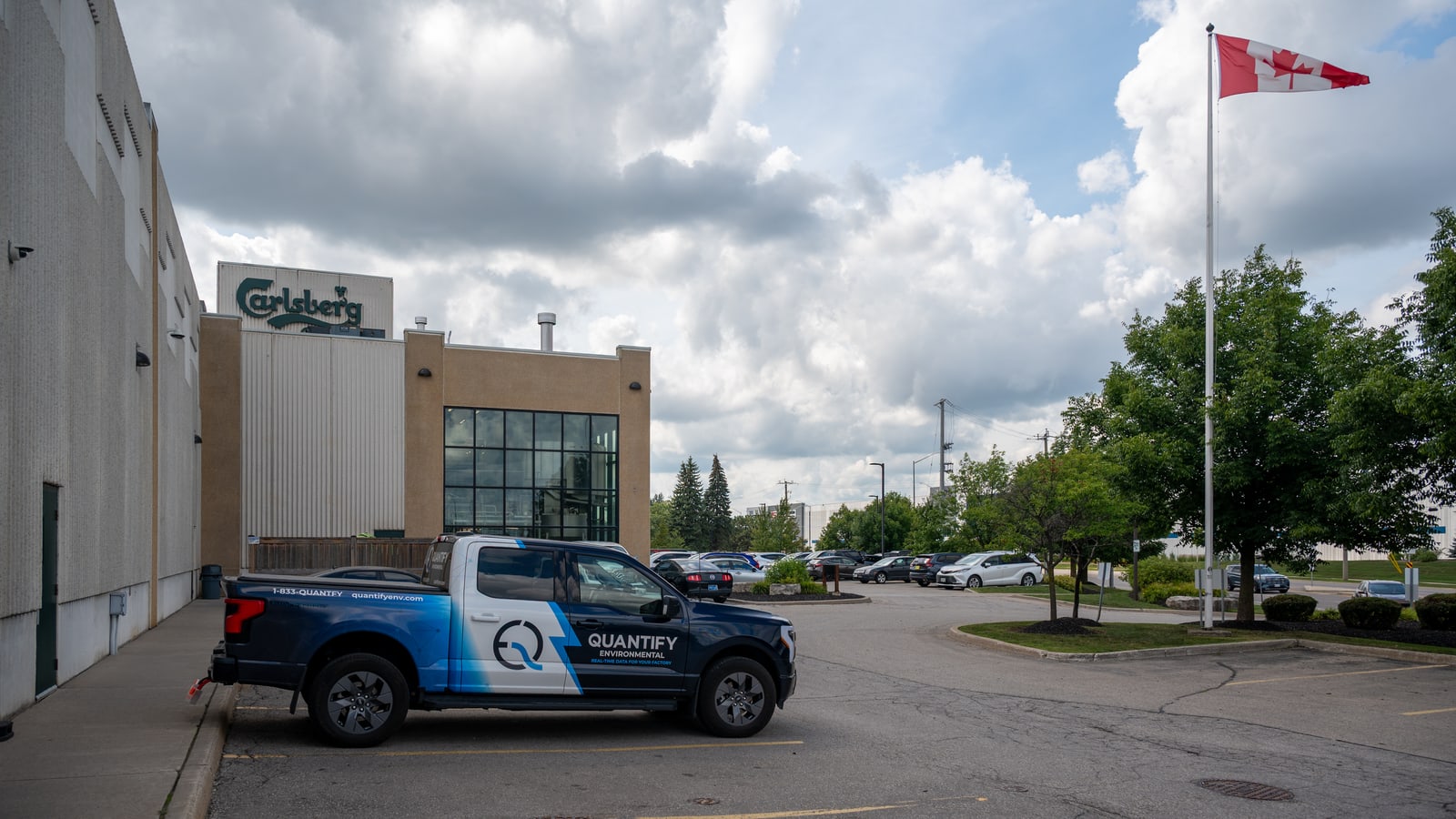
Between 2023 and 2024 water use at the Carlsberg Canada brewery fell by more than 100,000 m³, and the Region of Waterloo gave the site its 2024 Water Efficiency Excellence Award for it.
We connected Carlsberg Canada’s existing meters and added flow monitoring to show where water was going. The data led to a pasteurizer scheduling adjustment, and brewery water use fell by more than 100,000 m³ between 2023 and 2024.
Client: Carlsberg Canada
What the data showed
Hover or arrow-key across the trace to read any interval. The flagged point is the one that started the conversation.
| Interval | Before · idle floor open (L/min) | After · idle floor closed (L/min) |
|---|---|---|
| 00:00 | 14 | 0 |
| 00:30 | 15 | 0 |
| 01:00 | 16 | 1 |
| 01:30 | 15 | 0 |
| 02:00 | 15 | 0 |
| 02:30 | 15 | 0 |
| 03:00 | 16 | 0 |
| 03:30 | 15 | 0 |
| 04:00 | 15 | 1 |
| 04:30 | 16 | 0 |
| 05:00 | 14 | 0 |
| 05:30 | 15 | 1 |
| 06:00 | 14 | 0 |
| 06:30 | 15 | 0 |
| 07:00 | 15 | 0 |
| 07:30 | 15 | 0 |
| 08:00 | 33 | 14 |
| 08:30 | 33 | 14 |
| 09:00 | 33 | 15 |
| 09:30 | 34 | 15 |
| 10:00 | 33 | 14 |
| 10:30 | 34 | 15 |
| 11:00 | 14 | 0 |
| 11:30 | 14 | 0 |
| 12:00 | 15 | 0 |
| 12:30 | 16 | 1 |
| 13:00 | 33 | 14 |
| 13:30 | 32 | 14 |
| 14:00 | 32 | 15 |
| 14:30 | 33 | 14 |
| 15:00 | 33 | 15 |
| 15:30 | 33 | 15 |
| 16:00 | 16 | 1 |
| 16:30 | 15 | 0 |
| 17:00 | 14 | 0 |
| 17:30 | 15 | 0 |
| 18:00 | 15 | 0 |
| 18:30 | 15 | 0 |
| 19:00 | 15 | 0 |
| 19:30 | 16 | 0 |
| 20:00 | 15 | 0 |
| 20:30 | 15 | 0 |
| 21:00 | 15 | 1 |
| 21:30 | 16 | 0 |
| 22:00 | 15 | 0 |
| 22:30 | 15 | 0 |
| 23:00 | 16 | 0 |
| 23:30 | 15 | 0 |
| Before | One invoice a month, with water running between production runs and overnight |
|---|---|
| After | Every major water user metered, and the pasteurizer on a schedule set by the data |
| From | To | Value (L/min) |
|---|---|---|
| Municipal supply | Brewhouse | 41 |
| Municipal supply | CIP | 28 |
| Municipal supply | Pasteurizer | 19 |
| Municipal supply | Packaging washdown | 17 |
| Municipal supply | Boiler and tower | 12 |
| Recovered loop | CIP | 9 |
| Recovered loop | Packaging washdown | 6 |
The published totals are the figures in the proof register, with their sources. The interval shape is drawn from the same period and is flagged as such in the dataset.
Background
“They came to us with a specific challenge: one monthly water bill, one big number, almost no visibility into where that water was going.”
A brewery’s water is not one thing. It is process water, pasteurizer water, CIP, washdown and packaging, and until it is metered separately the monthly invoice cannot tell anyone which of the five moved. The quote above is the whole problem in one sentence, and the first week of meter data is what answered it.
The problem
“Within the first few weeks: the pasteurizer was consuming water outside of production hours. When the line was idle (between runs, overnight), water was still flowing.”
The readings connected water use to the hours when the line was idle.
How we found it
Flow meters on the pasteurizer water circuit, plus connection of the meters Carlsberg already owned (Neptune Mach 10, Endress+Hauser, IFM) and PLC data via Scadametrics signalizers. Nothing was ripped out.
What changed
“The fix was a scheduling adjustment. No new equipment. No capital expenditure. Just a change informed entirely by data.”
More than 100,000 m³ of water, between 2023 and 2024. That is the reduction the Region of Waterloo recognized with its 2024 Water Efficiency Excellence Award, and the one CTV News Kitchener reported on 13 November 2025. It is measured on the meters we installed, on the incoming supply, the wastewater discharge and every internal process line, against the pre-installation baseline held in the same system.
Carlsberg’s work received recognition in the AIM2Flourish global sustainability programme, and Carlsberg Group’s European ESG team cited the site as a model for potential global replication.
The lesson
“You can’t fix what you can’t see.”
The brewery team now uses the meters to see where water is going and set the pasteurizer’s schedule from the data.
Sources: Region of Waterloo Water Efficiency Excellence Award 2024; CTV News Kitchener, 13 November 2025.
What changed
Before
One invoice a month, with water running between production runs and overnight
After
Every major water user metered, and the pasteurizer on a schedule set by the data
100,000 m³2023 to 2024
Measured across the incoming supply, the discharge and every internal process line.
Source: Region of Waterloo Water Efficiency Excellence Award 2024; CTV News Kitchener, 13 Nov 2025
In their words
This technology offers unprecedented visibility into our operations, making immediate water and steam conservation possible for the first time!
Derek Cairney, Utilities Specialist, Carlsberg Canada Inc.
Where to go next
The sector, the sibling studies, and the calculator that runs this same arithmetic on your own numbers.
Predictive maintenanceWaterBreweries & Beverage
A failing diaphragm pump, caught before it failed
Carlsberg Canada
A transfer line's flow signature drifted, the alert fired, and the diaphragm was replaced on a schedule instead of during a shutdown.
Scheduledreplacement
Compressed airWaterFood & Beverage ProcessingBulk Handling & Rail Logistics
More than $150,000 a year, taken out on the dashboard data
PDI Bulk
Metering PDI Bulk's water and compressed air showed where both were going, and within weeks the general manager had taken more than $150,000 a year out of operating costs on process adjustments alone.
$150,000per year
WaterManufacturing: Automotive, Plastics & Rubber
Chiller circuit leak isolated without a shutdown
An automotive factory
Continuous monitoring helped identify and isolate a leaking cooling loop while the production line remained in operation.
1 loopisolated
Find out what’s hiding in your factory.
Every study on this site started with somebody walking a floor and asking what the numbers actually were. Our team will do the same on yours and tell you honestly what we find.
Book a site visitAll case studies
or call 1-833-QUANTFY (1-833-782-6839)